F1 Tech | Adrian Newey's AMR26 is a rare jewel of engineering

The AMR26 is a unique car, featuring phenomenal technical solutions likely to be copied by other teams.
With just two hours remaining in Thursday afternoon's session at the shakedown in Barcelona, the AMR26 finally made its debut.
Adrian Newey's first Aston Martin design experienced several delays during its design and assembly phases, resulting in the team losing one of the three available days for testing.
The car ran in a black carbon livery, lacking sponsors, as the 2026 livery has yet to be revealed.
Despite the issues, the AMR26 looked phenomenal from a technical point of view, with extraordinary solutions in all the visible areas, both for mechanics and aerodynamics. Here’s an explanation of the key technical innovations behind this ambitious car.

Push-rode front suspension and massive anti-dive angle
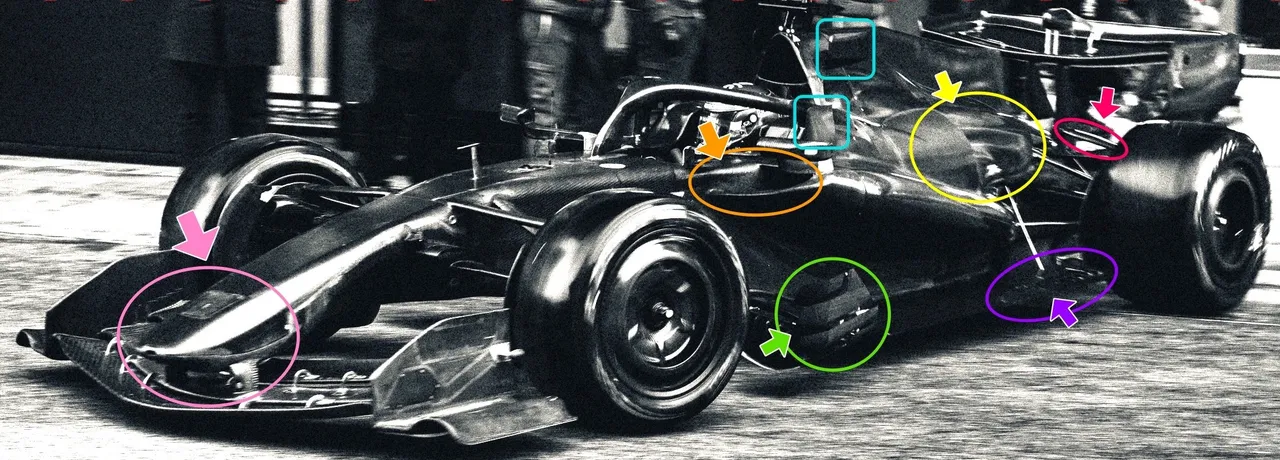
Starting to analyse the frontal view, a lot of details emerge: as for the nose of the car, it is very wide and thick along its entire length. Furthermore, the front wing currently has a rather basic and simple design, a sign that the designers' attention has been focused elsewhere.
Turning now to the front suspension, Aston Martin, like other top teams, has chosen the push-rod front suspension design, but with careful consideration of the attachment points for the arms.
As highlighted by the red circle, the front arm of the upper wishbone has been anchored at the highest possible point on the chassis, a solution very similar to the one adopted by McLaren in the 2024 and 2025 seasons.
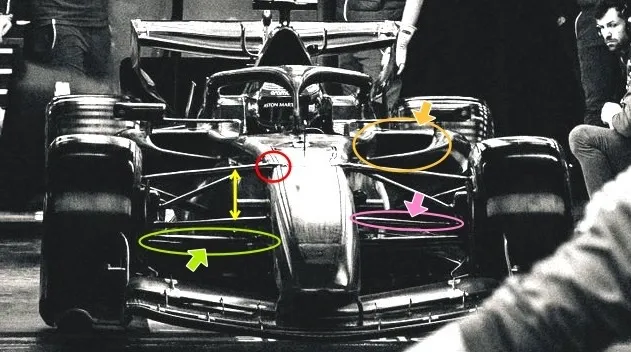
Furthermore, the front and rear arms of the upper wishbone have a massive height displacement (yellow arrow), a sign that the team wanted to maximise the anti-dive angle, not only for mechanical reasons but above all for aerodynamic ones (very similar to the MCL40).
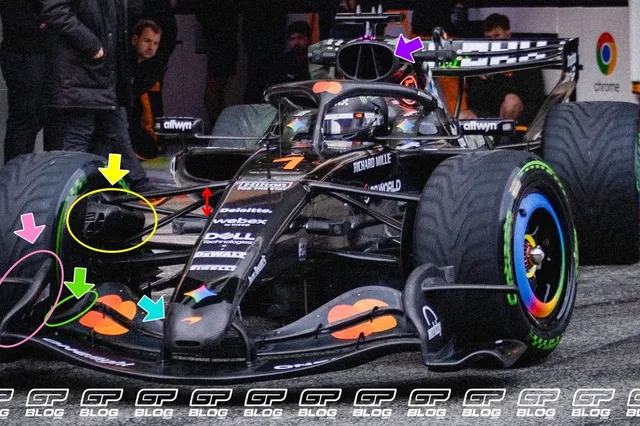
The lower wishbone and steering rack were also the subject of extensive study: similar to what was seen on the RB22, Newey also decided to position the steering rack higher (pink circle and arrow), while the lower wishbone arms were positioned much lower (green circle and arrow), precisely to improve aerodynamics and create an air channel under the suspension that would direct the inlet to the underbody.
Last but not least, this view highlights one last interesting detail: as shown by the orange circle and arrow, the sidepod cooling inlet has a visible underbite, in which the lower lip is longer and functions like a tray, dividing the flow directed towards the undercut and that which feeds the power unit.
Short sidepods and a suspension arm connected to the rear wing support
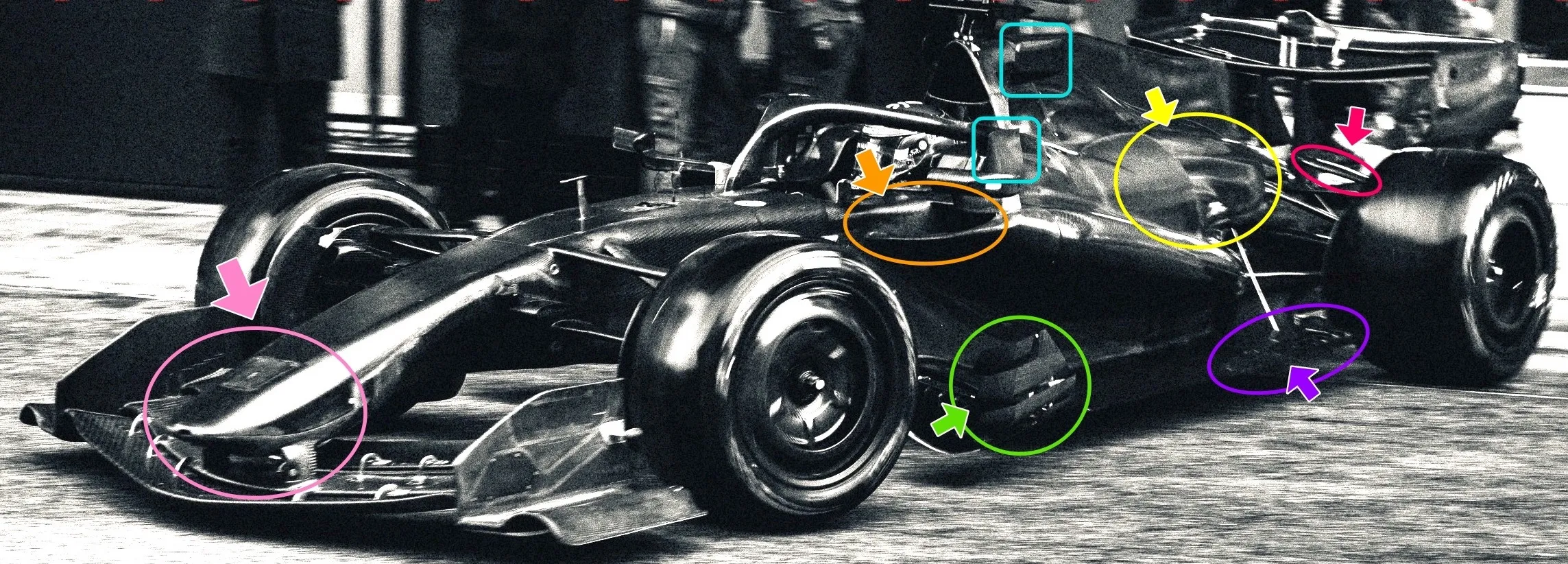
Now analyzing the side view, we can see how, as previously mentioned, the nose of the car is very wide and fat, even though the lower part is hollowed out near the chassis (pink circle and arrow).
The external floor fence has been appropriately shaped, dividing it into four horizontal elements (green circle and arrow): the three upper ones are of more or less the same width, while the lower one is much thinner and acts as a "knife" to generate a series of vortices that can seal the edge of the floor.
As already specified for the other cars, the slits between the fence elements allow the front tire wake to pass through and be pushed outward, preventing it from ending up under the underbody. As for the sidepods themselves, they have a very thin and compact shape and are also quite short.
Much like the SF-26, the AMR26 also features a massive undercut, a sign that engineers sought to free up as much space as possible under the cooling inlet to increase the flow of air towards the rear end of the car and the diffuser.
In this regard, the orange circle and arrow show the underbite cooling inlet described previously, which shows a very similar design to the one adopted on the RB19 in 2023.
As for the engine cover, it features two different winglets in different positions: as shown by the two light blue circles, the AMR26 features a vertical winglet near the shoulders of the halo, very similar to the version used by McLaren on the MCL39 in 2025.
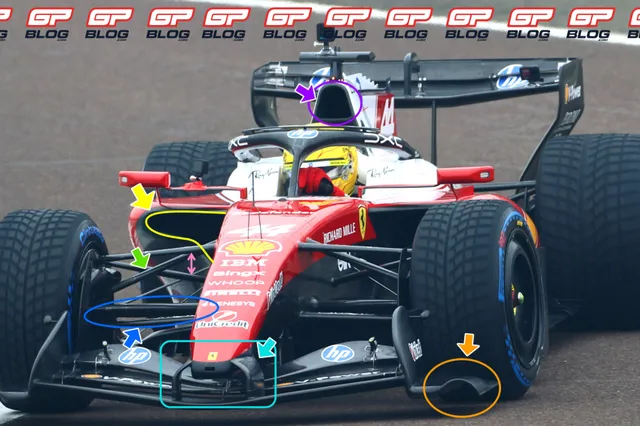
The purpose of this element is to clean up the flow towards the rear air, improving the car's efficiency and slightly increasing the downforce generated.
As for the horn-shaped winglet positioned next to the air scoop, it's a solution very similar to that adopted by many other teams and, likewise, aims to improve the car's overall efficiency. From this view, another detail is noticeable: the air scoop has a triangular shape, slightly wider than Ferrari's.
Furthermore, the engine cover features a massive exit midway along the side (circle and yellow arrow), behind which the bodywork has been hollowed out specifically to facilitate the expulsion of hot air and improve aerodynamic cooling efficiency.
As for the rear suspension, Newey decided to adopt a solution very similar to that used on Red Bulls in previous years: the trailing arm of the upper wishbone of the rear suspension has been anchored to the rear wing support pylons (circle and red arrow), for aerodynamic reasons.
Finally, the rear section of the floor features a series of 45° cuts, more numerous than those on other cars (see purple circle and arrow). These solutions aim to manage tire turbulence caused by the rolling tires.
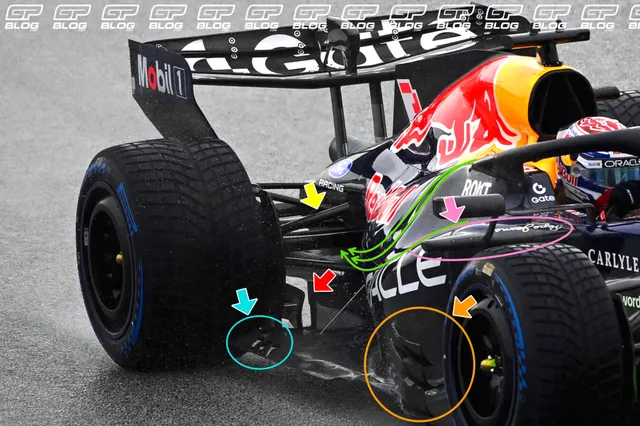
Analysing the last photo, it’s visible how the rear wing endplate has been carefully designed to obtain an airfoil-shaped external profile (yellow circle and arrow), which slightly increases the downforce produced.
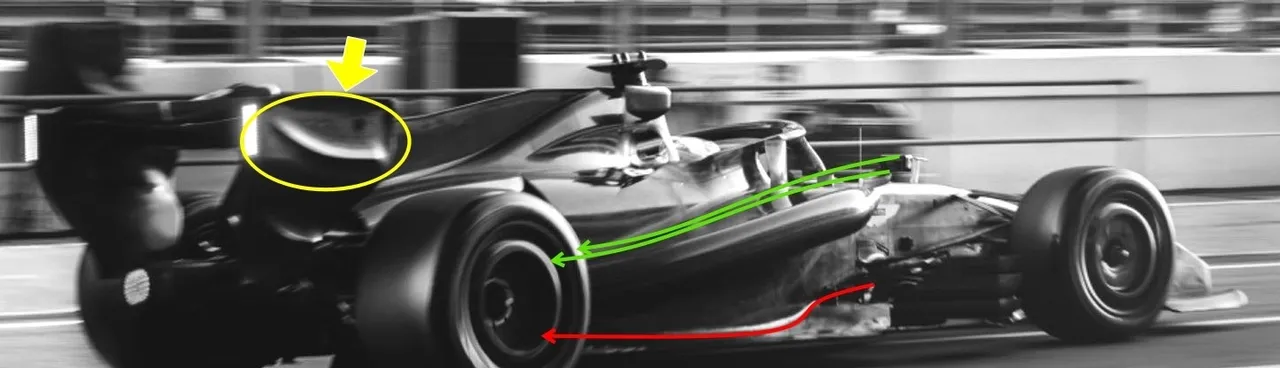
Furthermore, the red and green arrows show how the airflow splits into two channels above and below the sidepod.
In conclusion, the new AMR26 featured some very innovative concepts from the aerodynamic point of view, but it’ll be interesting to understand what impact these solutions have on performance.
With limited running in Barcelona, it was difficult to gauge the true potential of the AMR26, but the Bahrain testing will probably give an answer to all these questions and assumptions.
Read also

GPblog's F1 Paddock Update
Want to stay up-to-date with what happens in the F1 paddock? Then GPblog's F1 Paddock Update video is the perfect way to do it. Subscribe to GPblog's YouTube channel and turn on notifications to never miss the latest episodes.
Don't forget to follow F1 Paddock Update on Spotify as well!







Popular on GPBlog

Horner makes clear why a 'nicey-nicey' bond with Wolff will never happen

Lewis Hamilton back to his best should spark a warning for Norris and Verstappen

'Lewis Hamilton spotted on a date with American celebrity Kim Kardashian'