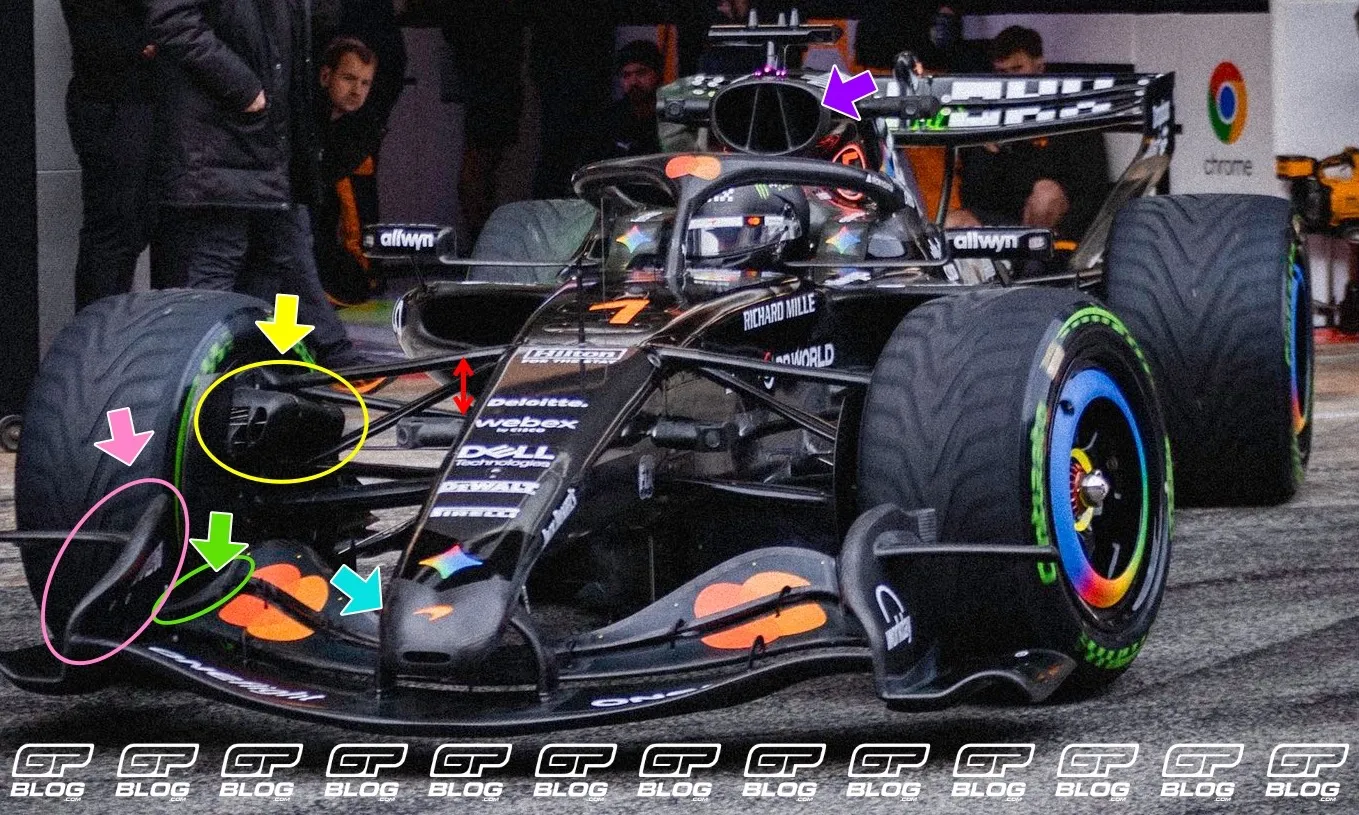
F1 Tech | McLaren makes Barcelona debut with bold MCL40

The new MCL40 made its debut in Barcelona this morning and already shows many innovative solutions.
McLaren was the last top team to debut its car at the Barcelona shakedown test, choosing to maximise the available days to develop the MCL40, as Andrea Stella highlighted during a McLaren event last week.
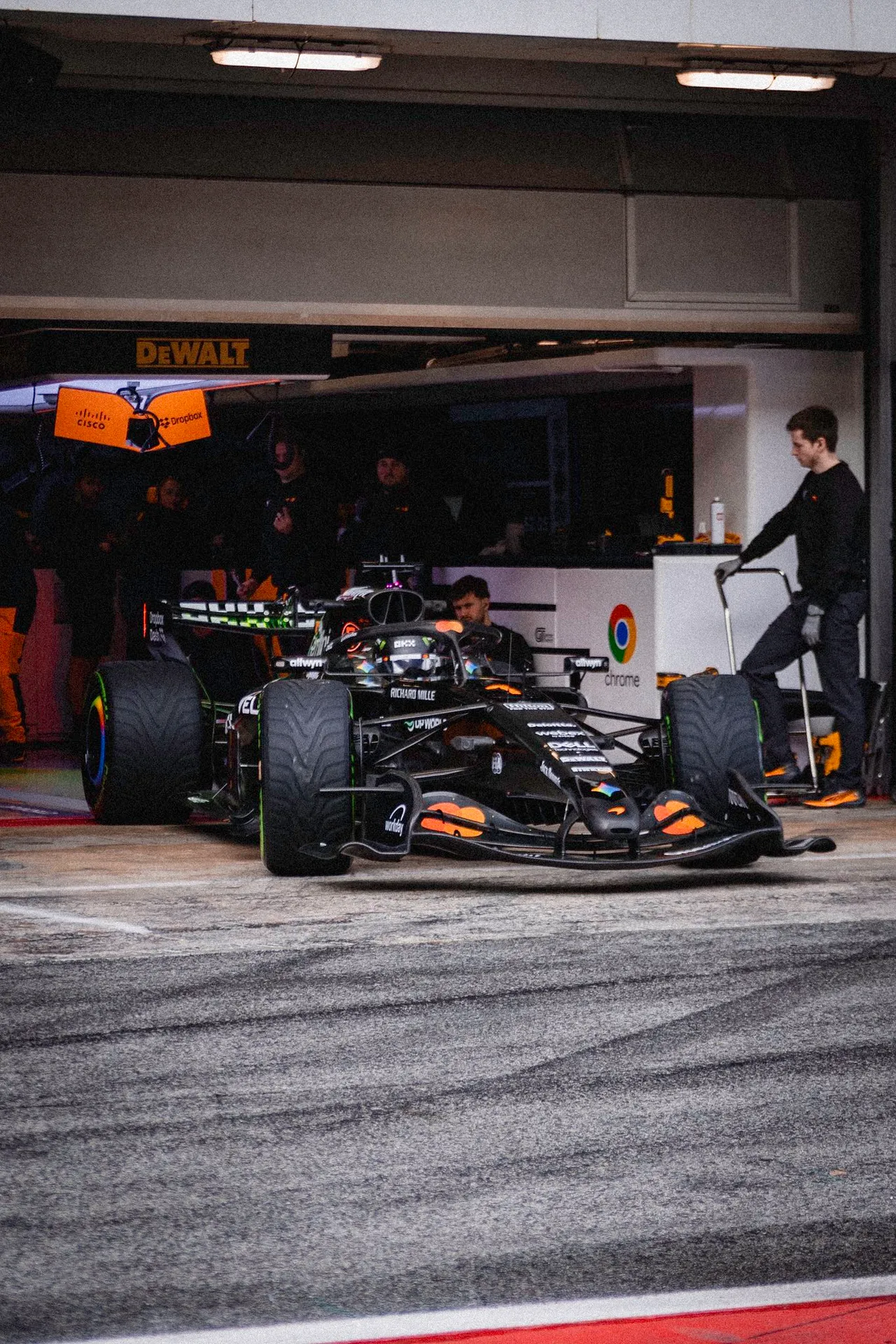
The Woking-based team only completed 34 laps with Lando Norris in the morning, basically checking that everything was working correctly on the car, without pushing.
The first pictures published allowed us to look for all the details that distinguish the MCL40 from other cars, and despite the very limited number of shots available, there are already a few different elements (and some very similar) to the solutions adopted by other top teams. Let’s try to have a look at the first details that emerged.
Lots of interesting solutions on the front wing and suspension
After releasing the first images of the livery on Monday, McLaren debuted on track this morning, with the MCL40 showcasing solutions similar to those in the renders.
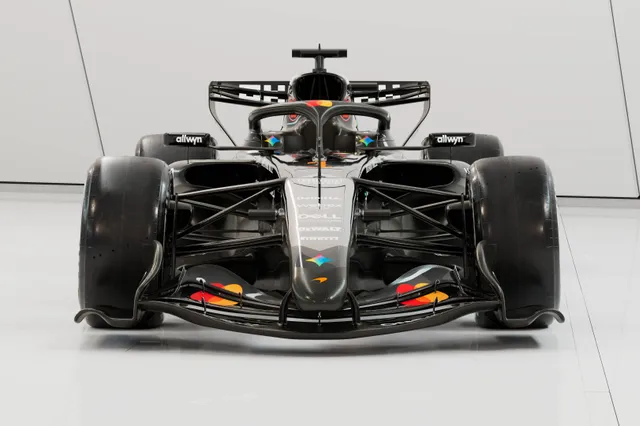
The first pictures shared by the team reveal only the front end of the car. Analysing the front wing, the mainplane has a pronounced spoon shape, with the tips near the endplates arching upwards to push air outwards from the front wheels.
As concerns the endplate, as shown by the pink circle and arrow, it features a curvature that favours the in-washing effect, directing most of the air towards the bodywork of the car.
Moreover, the MCL40 also features two trays connected to the front wing endplate. The upper tray is flat and likely generates vortices at the tip to help push air around the front tire, reducing drag.
In line with this goal, the lower tray features a shell-shaped leading edge on one end: this solution is very similar to the one seen on the RB22 and on the SF-26 and mainly aims at generating conveying inside this channel and generating a series of vortices to push the air towards the outside of the front wheels.
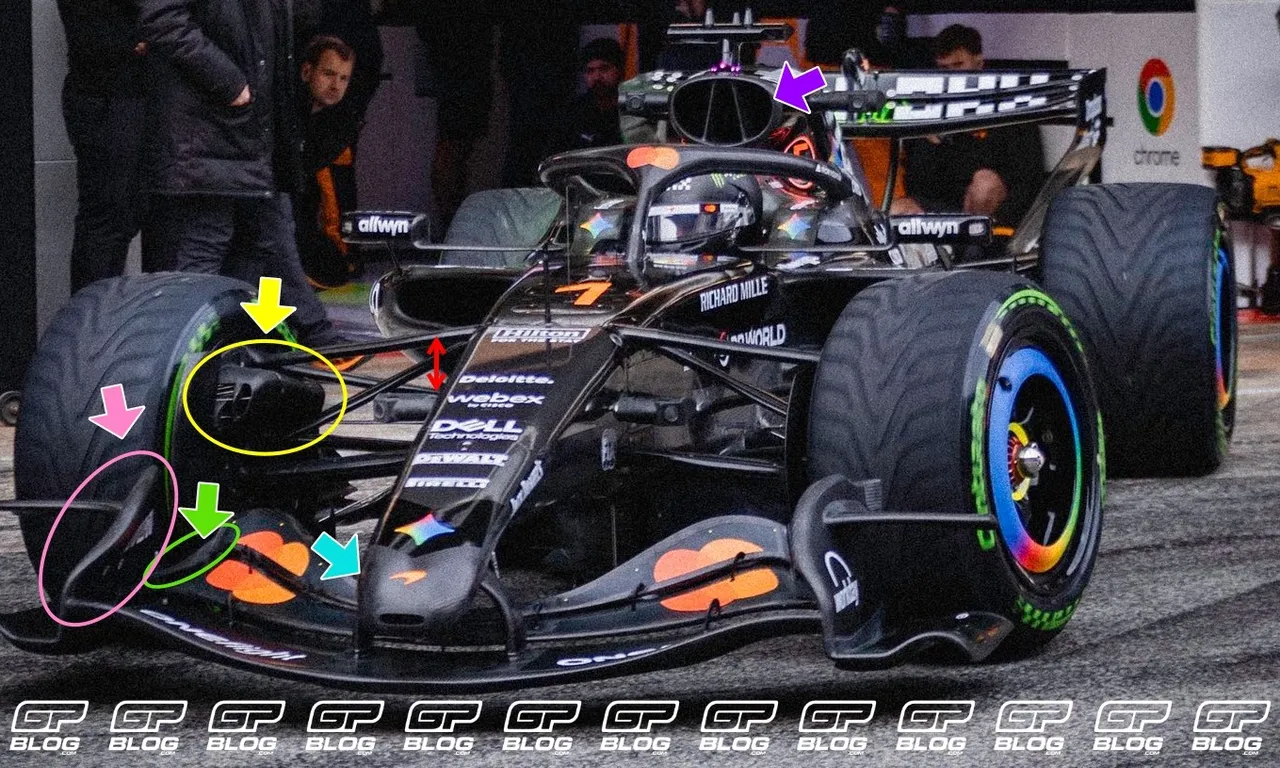
As you can see in the photograph, the wing has a wavy profile to generate vortices in the lower part of the endplate, near the wing. In this regard, McLaren adopted a very innovative solution also at the wing tip: while other top teams connected the top two flaps with a flat and short flap, McLaren engineers instead designed a small, knife-shaped flap, with a chord that decreases as it connects to the endplate (green circle and arrow).
This element also has a different inclination, to try to encourage the generation of vortices that begins at the leading edge of the endplate. Looking at the nose of the MCL40, it is quite narrow and flat along its entire length, featuring a small cooling vane at the front (light blue arrow).
The pylons of the nose are attached to the rearmost point of the mainplane and also connect to the second flap. This is a different solution from what other top teams did and probably gives the MCL40 an advantage when the DRS opens on the front wing.
Having now a look at the front brake duct, it shows a much more complicated and elaborate design than the one spotted on the Mercedes during their shakedown at Silverstone: the front opening that collects air for brake cooling is already quite large and features two distinct sections.
Furthermore, the channel that pushes hot air outward is wavy and shaped to work in synergy with the front and rear arms of the upper triangle (yellow circle and arrow).
As for the suspension scheme, McLaren adopted on their MCL40 the push-rod as all other top teams did, but similarly to 2025, they took a very aggressive approach in the displacement of the front and rear arms of the upper triangle: the anti-dive angle chosen (red arrows) is massive and very similar to the one spotted on the MCL39.
This design probably gives strong aerodynamic and mechanical benefits if engineers decided to carry it over to a different car as well. Last but not least, this perspective allows us to appreciate the air scope design: as shown by the purple arrow, in fact, it has an oval shape very similar in dimension to that of the MCL39, proof that the Mercedes power unit, despite being completely new, still needs more or less the same amount of air.
From this perspective, the cooling inlets have an oval shape, with the lower lip also acting as a tray, following a trend that emerged in 2023 with the ground-effect cars.
This design tends to generate a high-pressure area on the top surface of the tray, increasing pressure and favouring the amount of air that feeds the engine, while creating a bigger undercut to increase the amount of air pushed towards the rear end of the side pods and floor, for aerodynamic benefits.
In conclusion, these are the first bold and intriguing details of the new MCL40, which debuted at the Circuit de Barcelona-Catalunya.
World champion Lando Norris will continue familiarising himself with the new car and systems this afternoon, aiming to complete significant mileage without major issues.
Read also
GPblog's F1 Paddock Update
Want to stay up-to-date with what happens in the F1 paddock? Then GPblog's F1 Paddock Update video is the perfect way to do it. Subscribe to GPblog's YouTube channel and turn on notifications to never miss the latest episodes.
Don't forget to follow F1 Paddock Update on Spotify as well!








Popular on GPBlog

Russell delivers standout display as Mercedes turn heads in Barcelona

F1 LIVE | Barcelona Pre-Season Test - Day 3

Red Bull family car stops on track for the first time: Lindblad causes red flag