F1 Tech | Red Bull prepares to fully attack in 2026 with the new RB22

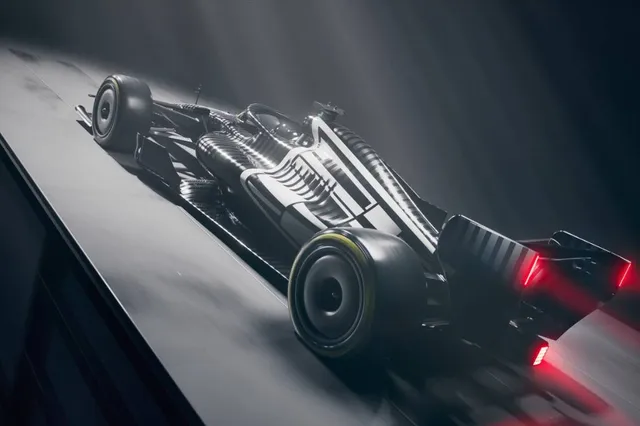
Red Bull Racing unveiled their new RB22 yesterday, showcasing innovative technical solutions that reflect the team's hard work back at the factory.
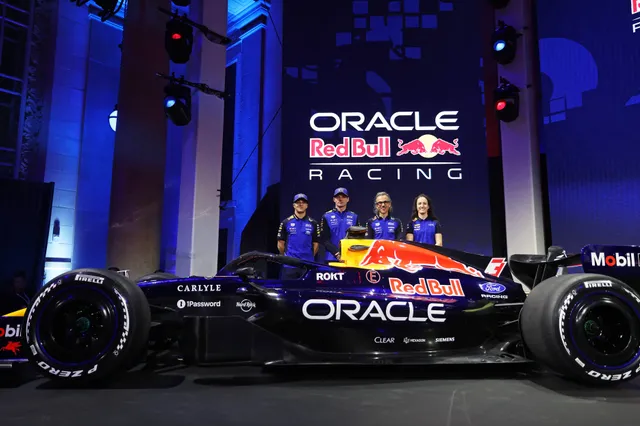
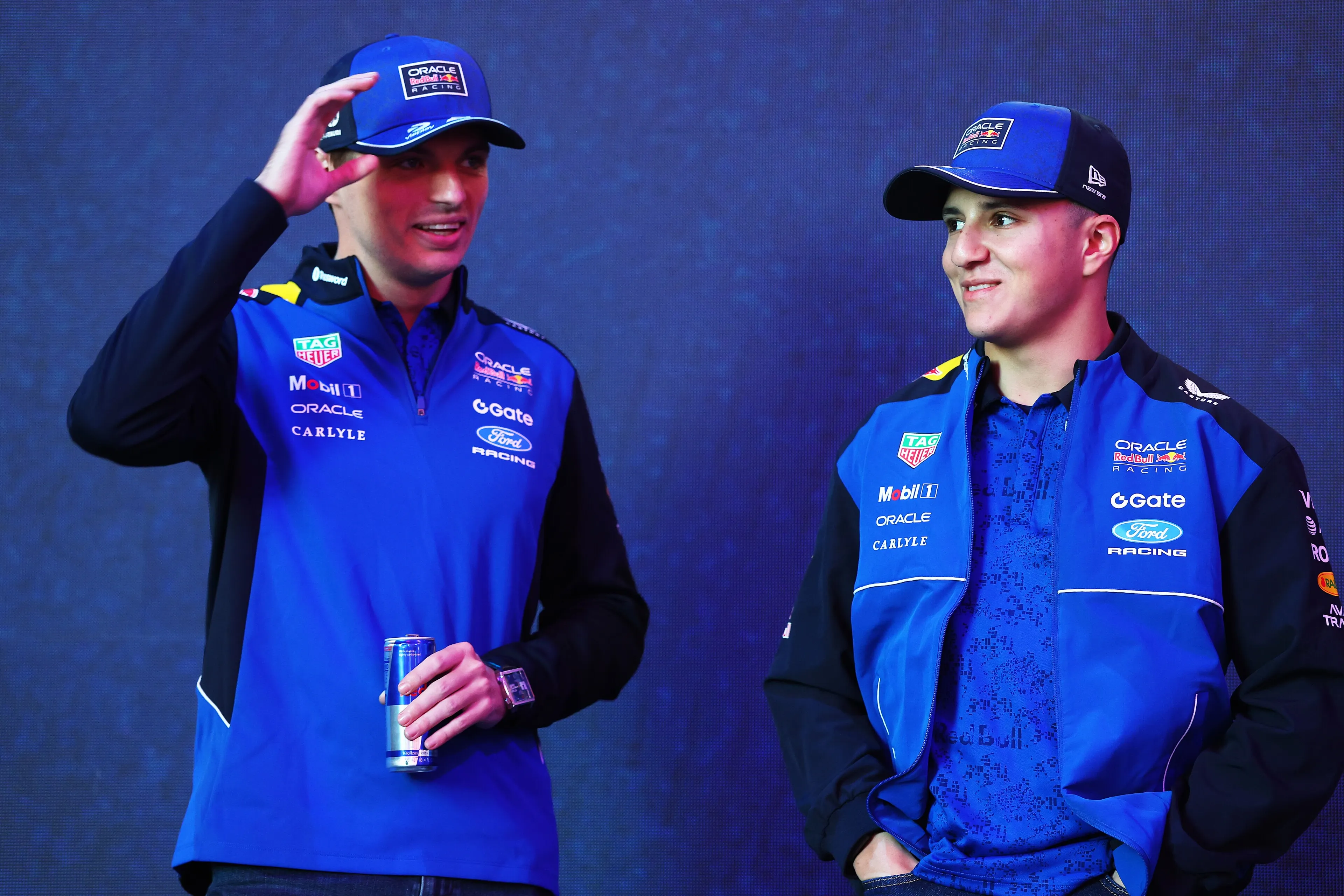
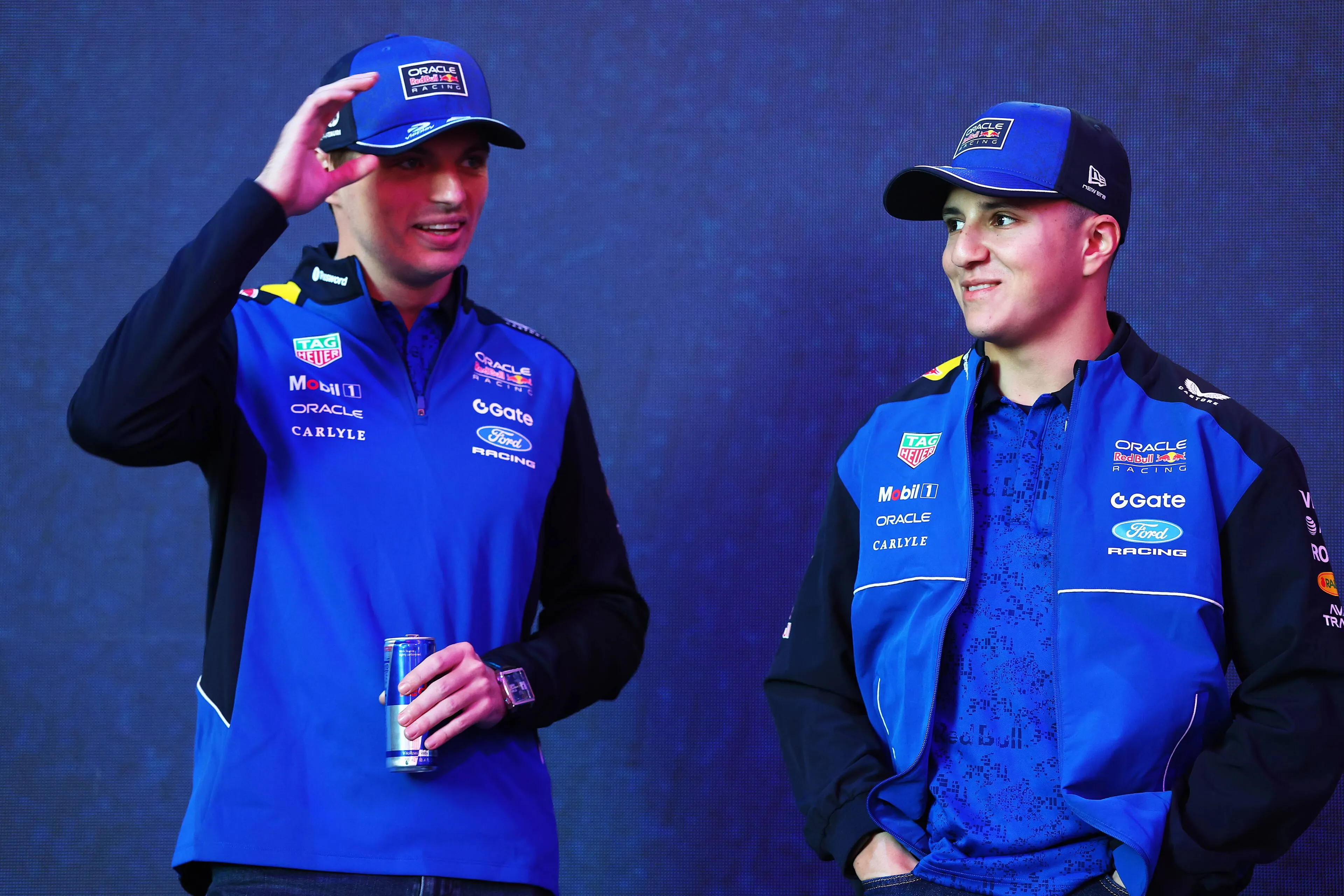
Red Bull Racing and Ford have launched the new RB22’s livery that is going to be used in 2026 and have completely explained the new Power Unit, manufactured for the first time ever in Milton Keynes.
Following the launch, the team shared the RB22 renders online, revealing notable mechanical and aerodynamic solutions that reflect the team's thorough work on both the engine and other key car aspects. Let’s try to understand where the main changes and differences lie.
A new philosphy on the front wing
A couple of days ago, Red Bull Racing unveiled its new car for 2026, the RB22, which will be equipped with an engine developed in collaboration with Ford Racing.
Not by accident, in fact, the launch was held in Detroit, the historical home of the American brand, proof of the important moment for Ford.
Beyond marketing and partnership considerations, however, the renders of the new car appeared quite realistic, with numerous interesting technical solutions.
Starting to analyse the frontal view in the image below, the front wing shows a completely different size and shape compared to the version used until 2025: it’s made of three main elements and, as shown by the green arrow and line, the mainplane has a waved leading edge in the portion close to the endplate, to increase the chord of the first element and generate more downforce.
Moreover, the top flap has a curved trailing edge (pink arrow), not only to generate more downforce in the external part, but also to push the airflow towards the outside of the front tyres, favouring the out-washing effect.
The endplate is inclined inwards, mainly to push as much air as possible to the inside of the front tyres, delivering air to the bodywork and favouring efficiency (purple line and arrow).
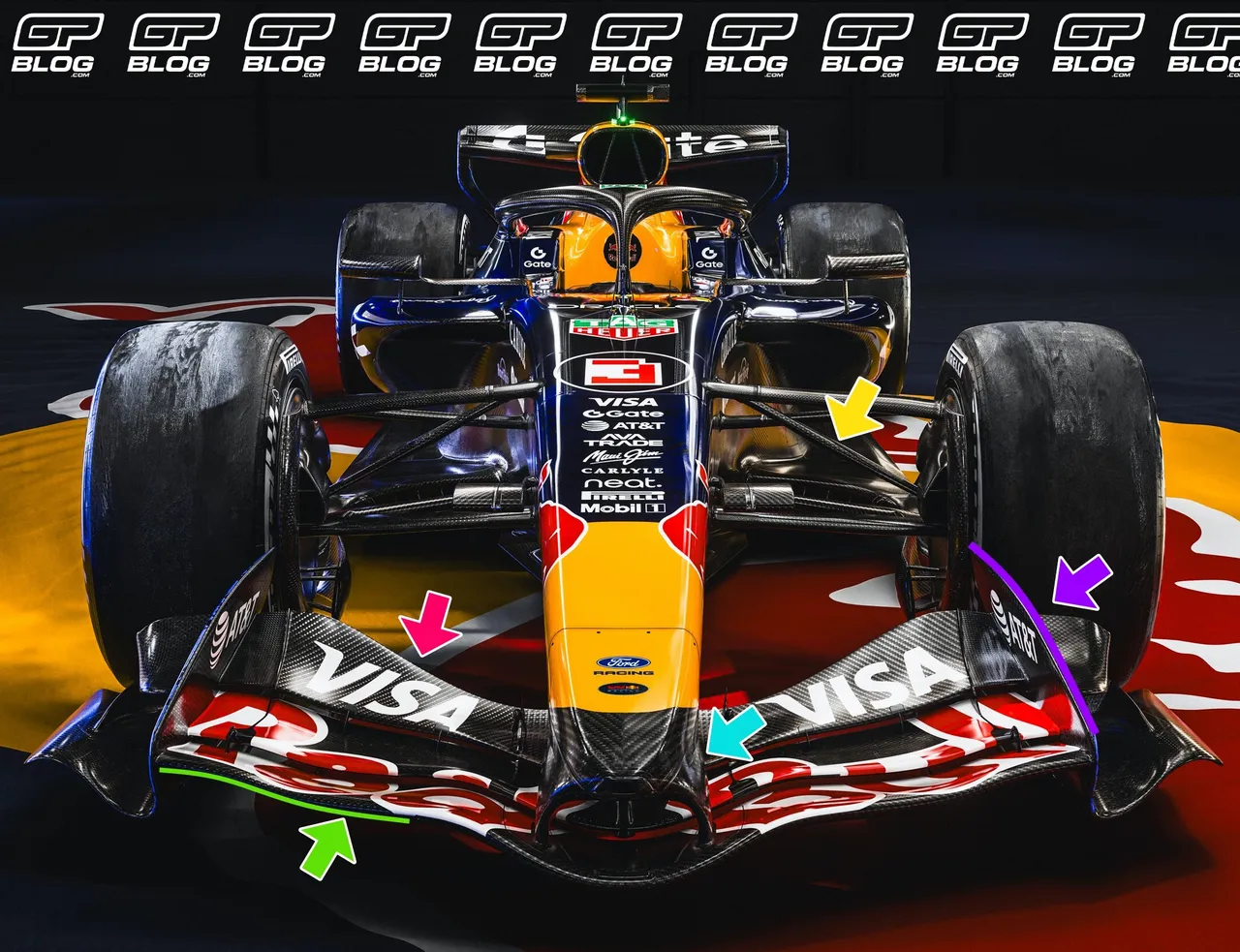
Last but not least, the nose has a very unique shape: in addition to having a very tapered shape, it has been joined to the two supports in a very detailed way, giving the area indicated by the blue arrow the shape of a small winglet that can push the air to the edges of the nose.
Related to the need of increasing efficiency as much as possible, the engineers decided to place the actuator of the front wing just under the nose, to minimise the drag generated and avoid placing two different actuators for each side of the front wing.
The last interesting detail that emerges from the frontal view lies in the suspension’s design: as shown by the yellow arrow, the Red Bull Racing engineers decided to adopt a push-rod front suspension scheme, in contrast with the pull-rod scheme adopted until the end of 2025.
This choice is related to the different nature of the two cars: the ground-effect cars needed a very stiff and stable mechanical platform to make the Venturi channels work at their best and produce the maximum downforce possible.
On the other side, thanks to the comeback to the flat floor, the cars will have a much bigger working window and won’t need to be run as close to the ground as they did during the last four years.
As a result, engineers have adopted a more optimal solution for this generation of cars, aided by the lower downforce generated by the floor, which will probably feature a high rake-angle, to maximise the downforce generated on the front axle.
Read also


Smaller sidepods and push-rod rear suspension
Moving to the lateral view, more details emerge: as highlighted by the orange arrow, the RB22 will feature a shark inlet very similar to the design adopted on the RB20. It’s still unclear if this version will be used in Bahrain, but the team adopted a well-known solution from the design and aerodynamic point of view.
This design creates a high-pressure area around the cooling inlet, boosting airflow to the engine while shielding against the front tire wake, which could otherwise reduce downforce.
As far as the big bargeboard or floor fence highlighted by the green arrow, it shows a much more realistic and more elaborate design compared to the FIA model: this element has, in fact, been divided into three horizontal bands, preceded by a vertical element.
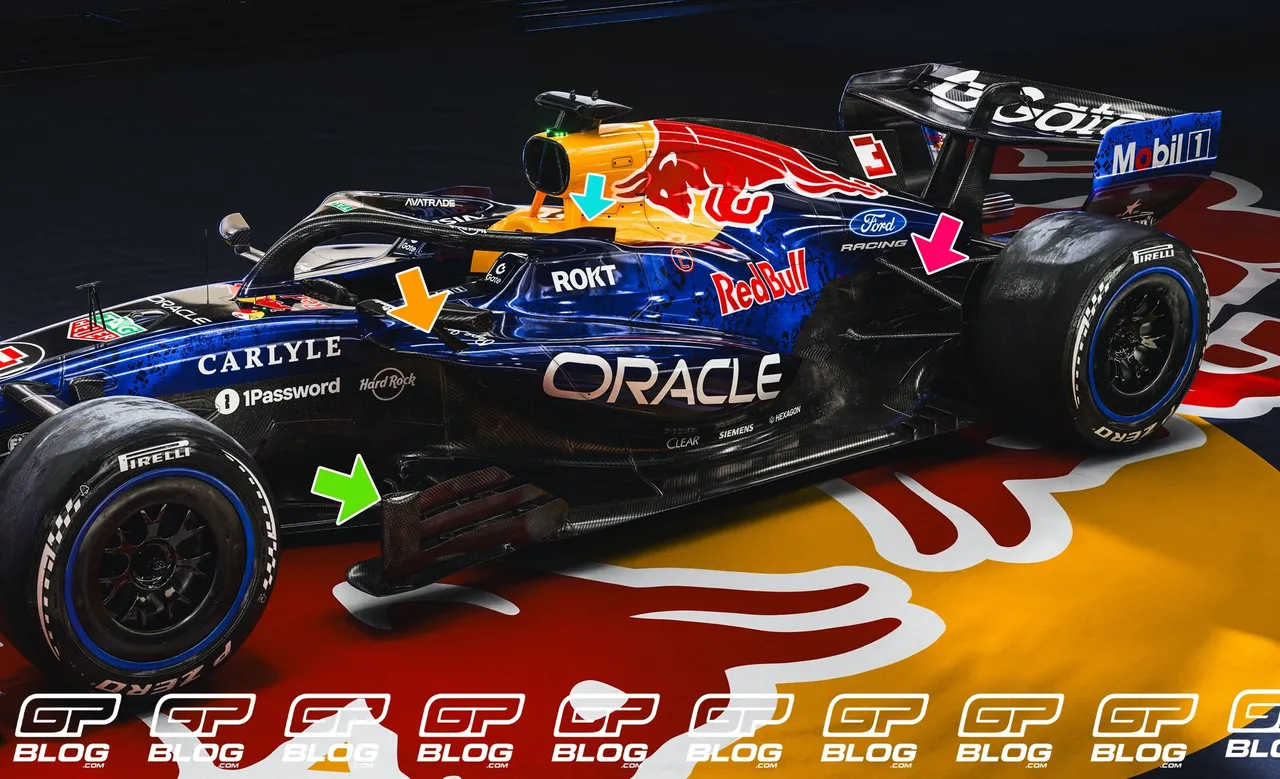
The goal is to deflect the turbulence of the front wheels with the vertical element, and then exploit the high-pressure zone in front of the sidepods to force this turbulent air through the three slots, preventing it from being sucked under either the floor or the sidepod.
An important detail is the rear suspension system, which also uses a push-rod design (indicated by the pink arrow). This solution aligns with those adopted by other top teams.
Last but not least, the light blue arrow points at a very small winglet placed at the halo shoulders, designed to partially recover the turbulence losses related to this element and clean the airflow towards the engine cover and rear wing.
Interesting solution to push the turbulence outside
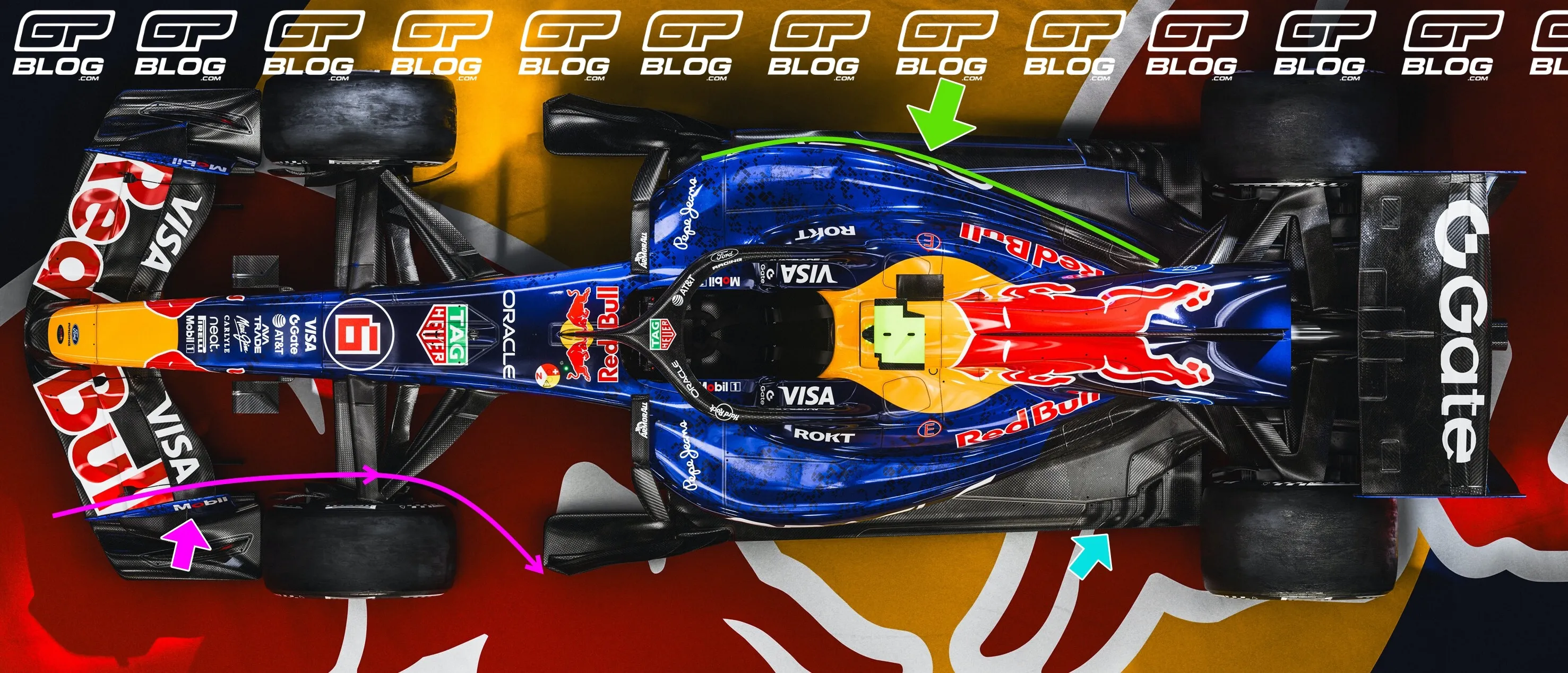
Moving on to analyse the view from above, more interesting details emerge: as shown by the pink arrow and lines, the endplate of the front wing is designed to maximise the in-wash effect.
The inclination of this element, in fact, should push the air inside the front tyre, to then be pushed towards the outside right behind the tyre, to keep the wake away from the floor.
Moreover, the green arrow and line point at the sidepods’ design from above: despite still having a sloping shape, it is much shorter compared to the version used on ground-effect cars until the end of 2025.
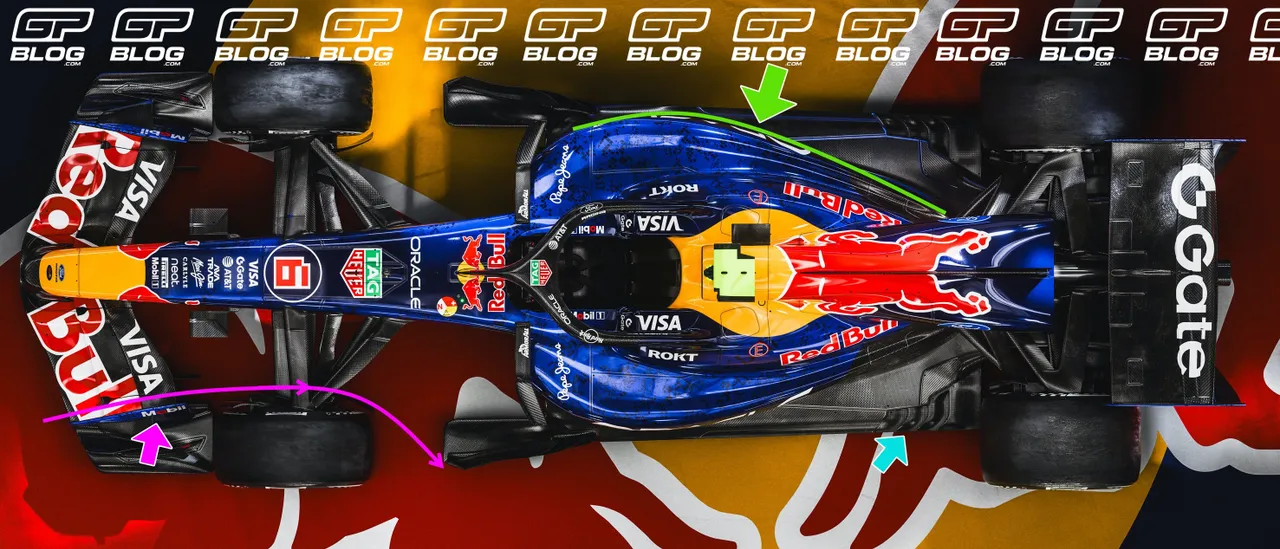
The goal with this new generation of cars is to maximise the free surface of the floor, to allow air to flow undisturbed and generate as much pressure difference between the two sides as possible, as this translates into downforce.
Another interesting detail is the floor’s design just in front of the rear tyres: as highlighted by the light blue arrow, it shows a series of 45° cuts, which serve to manage tire squirt and keep it away from the diffuser.
This solution is very similar to the designs used until 2020, when cars still had flat floors.
Despite being only the launch version, is really interesting how many details this new car showed, even if the continuous work and research back at the factory will see the car change massively between Melbourne and Abu Dhabi, as explained by Red Bull Racing’s Team Principal Laurent Mekies during the press conference in Detroit: “I think the main thing about doing racing this year is going to be the incredible development rate that you are going to see on both chassis side and on the inside. So we are used to the development rate.”
“If you look at last season, on the last year of the stable regulations, we could still see teams that have turned around things for the season. Take that, multiply by four next year. So what we'll see in Melbourne may be very different to what you will see in Abu Dhabi. So to your point, next year is a development race before anything else.”
In conclusion, the new RB22 featured a lot of different and innovative technical solutions, but it’ll be interesting to see if some of these solutions will be adopted by other teams as well, as the real shapes of the different cars will probably be seen only in Bahrain during the second session of testing.
Read also
GPblog's F1 Paddock Update
Want to stay up-to-date with what happens in the F1 paddock? Then GPblog's F1 Paddock Update video is the perfect way to do it. Subscribe to GPblog's YouTube channel and turn on notifications to never miss the latest episodes.
Don't forget to follow us on Spotify as well!





Popular on GPBlog
Wolff and Mercedes submit request for Verstappen: Nürburgring race must be rescheduled
Verstappen issued Hamilton warning ahead of 2026 F1 Regulations

F1 Today | Mercedes submits request for Verstappen, Schumacher warns Ferrari